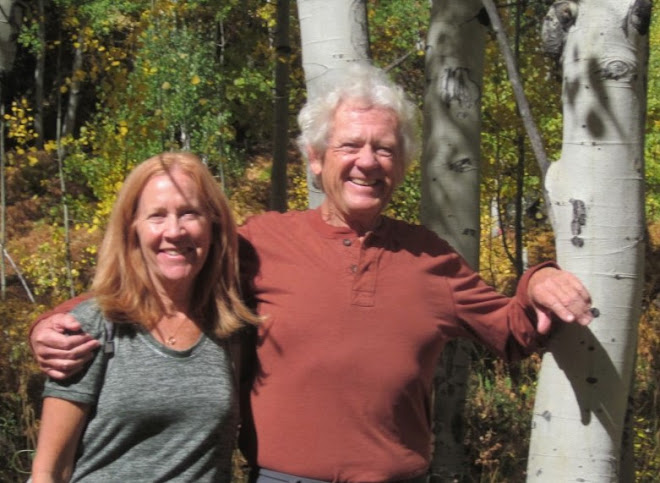
Spring may be late, the weather cool; but the advantages are that the countryside across Arkansas & Oklahoma and Northern Texas are exceptionally green. Springtime has burst out with flowers and floral scents. New buds were all around us. This was the perfect time to visit this part of the country.
The Crystal Bridge Museum of American Art is in Bentonville Arkansas and was sponsored by Alice Walton (of Wal-Mart heritage). Admission is free and houses ½ billion dollars of artwork. The amazing buildings were designed by Moshe Safdie who also designed buildings throughout the world, including Habitat (part of Expo ’67) in Montreal that we saw this summer. The grounds had flowering landscapes, waterfalls and walking paths through the woods. Bentonville is the place where Sam Walton owned a “5&10”, and began his retail career. In 1940 he owned one Ben Franklin store. 1962 was when he opened the first “Wal-mart Discount City.” By 1990 it was the nation’s largest retail store. By 2010, there were 8,747 stores in the US, 4,343 international stores, and $405B in sales. It was kind of fun to see where it all started.
As we journeyed through the Southern States we kept encountering the “Trail of Tears.” We knew in general that this was a reference to the forced relocation of Native Americans to the West, but wanted to investigate further.
As European settlers poured into America, Native Americans found that their hunting grounds were shrinking. Continuing their way of life was impossible; so many chose to push further west where there were still wide open spaces. Since other Native Americans already occupied those regions, the newcomers were met with a variety of responses - from welcoming to vehement opposition. For example, as early as the 1780s, the Cherokees began moving into Osage territory and were not well received. Fort Smith, Arkansas, was founded to try to contain a volatile Indian feud between the Osage and Cherokees. It was not too successful and ultimately, the Osage population was moved to Missouri and Kansas in order to have peace.
With the purchase of the Louisiana Territory, President Thomas Jefferson believed that America had lands that would not be settled for 300 years. He was mistaken as it took less than 100 years. But he thought that this new land would be perfect for the Eastern tribes of Indians to find new land more suited to their lifestyle and he “tempted” them to do so. Many Indians wanted to stay in the east, have their own lands within a state, and their own nation with separate and distinct laws.
In 1870, President Andrew Jackson gave the Indians an ultimatum. Become part of the State and abide by those laws where you reside, or get out and go west of the Mississippi (which were not states yet but only “territory.”) Some relocated to the new territory, but most did not. Many had property, including slaves, and ties (including businesses) to the local communities. For some, the idea of moving west was met with fierce resistance, triggering a forced relocation of over 60 tribes to the newly formed Indian Territory (now Oklahoma). Over the next eight years Indians were collected and accompanied while they walked to the Indian Territory. When those Indians who resisted moving were rounded up, they weren’t given time to gather their belongings, sell their property and holdings, much like we envision Nazi tactics toward the Jews. They could only bring what they could carry. Some brought their slaves who were set free by the army once they arrived in Government territory. They walked hundreds of miles west; many in shackles and at gunpoint. Hunger and disease, combined with adverse weather and tainted food supplies, claimed the lives of thousands. There were high mortality rates. The Cherokee relocation was the worst with 1/3 dying along the way. The moniker “Trail of Tears” is from that Cherokee journey, described as “the trail where they cried” in their own language. The term later extended to include all relocations during this period. The trail was actually many different routes, but all of them funneled through Arkansas on their way to Oklahoma.
Like most immigrants to the US, the Native Americans strived to blend into U.S. society by giving up their languages, religions, style of dress, and customs. Over half of the Indians who served in WWII never returned to these reservations. There is currently a resurgence of wanting to retain the old Indian ways, especially language. [We also saw this in Britain with Welsh in Wales and with Gaelic in Ireland.] The younger generation is learning the old tribal language and ways from the older generations. Traditions are being learned, but even the older generations may have lost some of the best qualities of the old ways such as extra senses, reverence for mother earth, their religion, and ceremonies and the meanings behind them.
In the Indian Territory, tribes were independent nations and Indians were not US citizens, but more like a neighboring nation. The “Indian Territory” was dissolved in 1887 and all the land given to the individuals on it. The Indians could sell the land to American settlers. Any unoccupied land was opened up to new settlers setting the stage for the Oklahoma Land Rush of 1889-1903. This Land Rush of 1889 was the first land run into the Unassigned Lands and included all or part of the 6 modern day counties of Oklahoma. The land run started with a cannon shot at high noon on April 22, 1889, with an estimated 50,000 people lined up for their piece of the available two million acres. The Unassigned Lands were considered some of the best unoccupied public land in the US. Due to the Homestead Act of 1862 signed by Abe Lincoln, settlers could claim lots up to 160 acres in size. Provided a settler lived on the land and improved it, the settler could then receive the title to the land. The army had orders to shoot anyone getting an early start. A number of the people who participated in the run entered the unoccupied land early and hid there until the legal time of entry to lay quick claim to some of the most desirable homesteads. These people came to be identified as “Sooners.” Today Oklahoma is known as the “Sooner State” and the Oklahoma Sooners are the much loved football team of the University of Oklahoma.
The Oklahoma Territory was open frontier and home to the lawless. As such it became the home of many outlaws (Billy the Kid, Belle Star, Dalton gang) and criminals (Barker gang, Machine Gun Kelly, Bonnie & Clyde, John Dillinger, Pretty Boy Floyd, Baby Face Nelson.)
One modern day criminal was Timothy McVeigh. In April 1995, he parked a rented U-Haul in the loading ramp of the Alfred P. Murrah Federal building, destroying it and killing 168 people. Today the Oklahoma City National (Bombing) Memorial at that site is quite moving. The perimeter of the [demolished] building is marked by pine trees, and inside the perimeter are the 168 chairs, one for each victim, placed in rows by which floor they were on. The children’s chairs are much smaller. One chair with a large bouquet of flowers marks the exact spot where the entryway was where the bomb exploded. There is a “survivor tree” – a 90+ year old American Elm, transplanted in the old parking lot as a message of resilience.
Favorite sons & daughters of Oklahoma include: Garth Brooks, Reba McIntire, Mickey Mantle, Johnny Bench, Wiley Post, Carrie Underwood, Woody Guthrie, Dr. Phil, but most importantly, Will Rogers by a landslide. He was an American cowboy and perhaps the best trick roper ever, a vaudeville performer, humorist, social commentator and motion picture actor. He was one of the world's best-known celebrities in the 1920s and 1930s and was dubbed "Ambassador at Large of the United States.” Rogers was adored by the American people and the feeling was mutual. One of his most famous quotes was: "I joked about every prominent man of my time, but I never met a man I dident [sic] like." He had (mostly) Native American parents and he joked that his “ancestors didn’t come over on the Mayflower, but they met the boat.” Some of his roping tricks from one of his silent films can be seen at http://www.youtube.com/watch?feature=player_detailpage&v=QZ0HgIBGl1E
We have always believed that every single State of this wonderful country has something unique about it, and history is remembered and re-lived in the museums and monuments. We are happy to share what we’ve learned with you. Until next time, Happy Trails!